Built and tested in real clinics

The multi-specialty EHR that documents the visit while you have it.

One clinic, four specialties, one codebase. The clinician records the encounter and MeMu AI returns a structured draft note — in the language of that specialty, with diagnoses and billing codes proposed. The clinician corrects it and signs.

Free trial — coming soon Download the documentation

Full product documentation · PDF · No email required
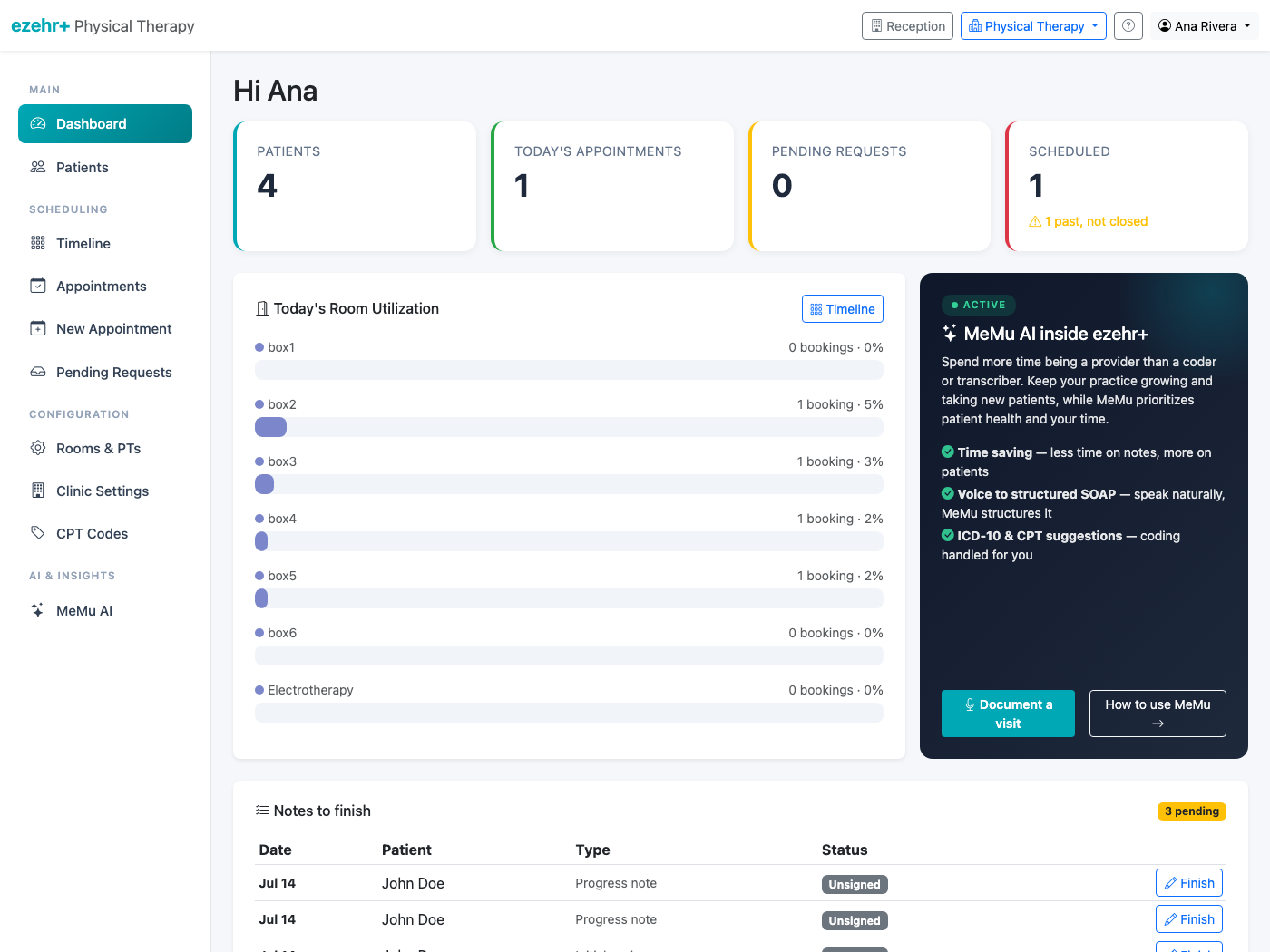
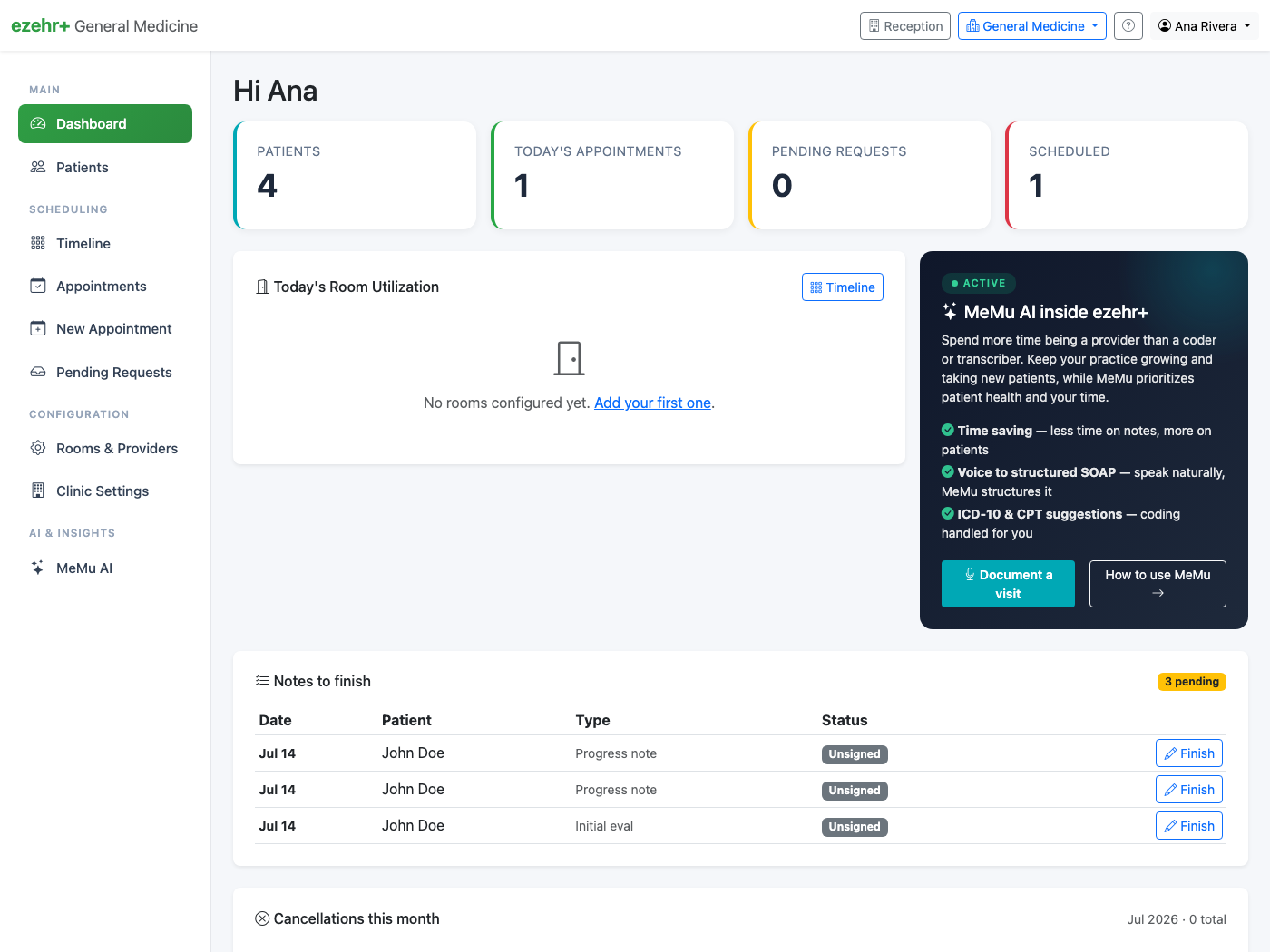
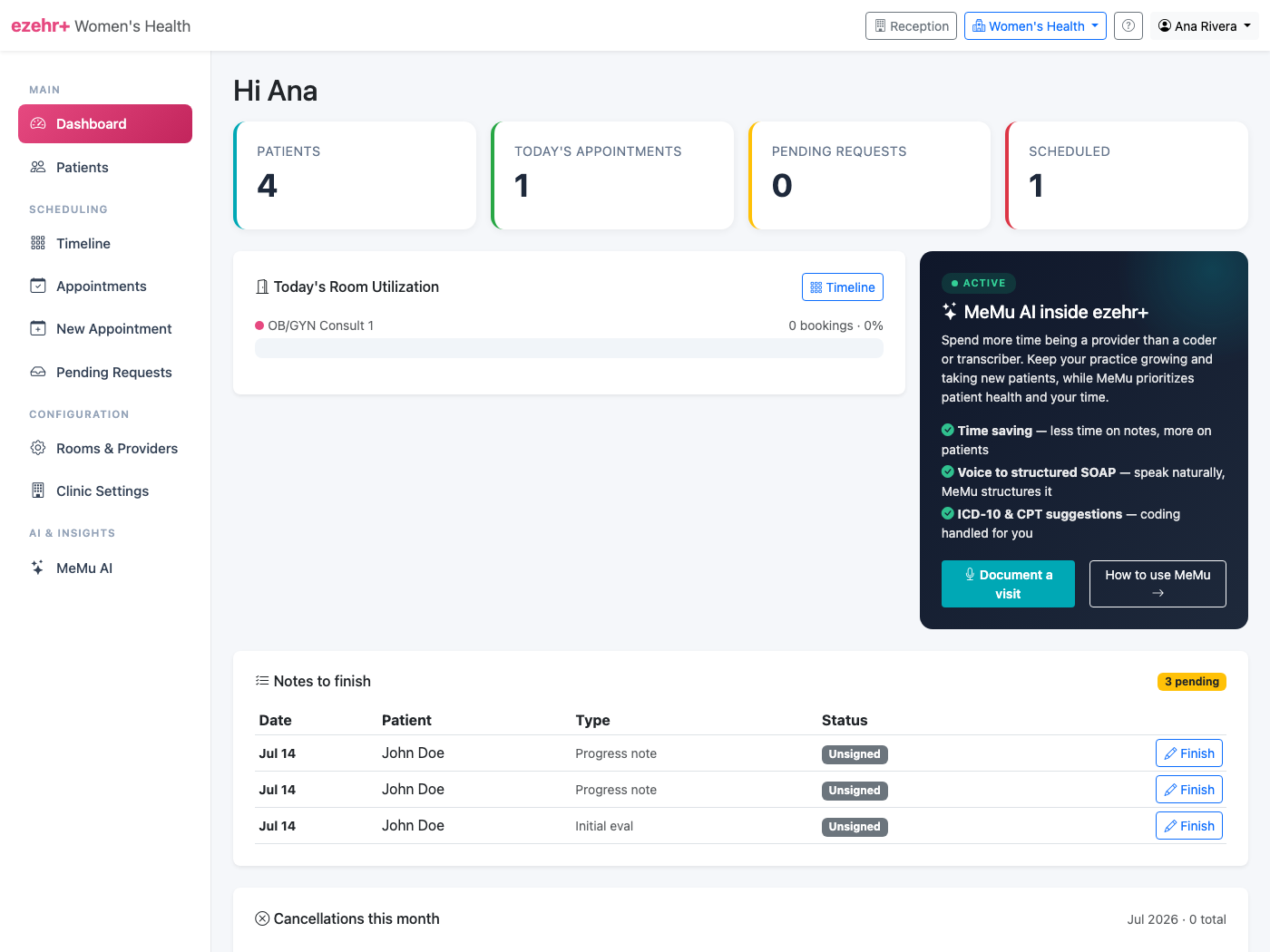
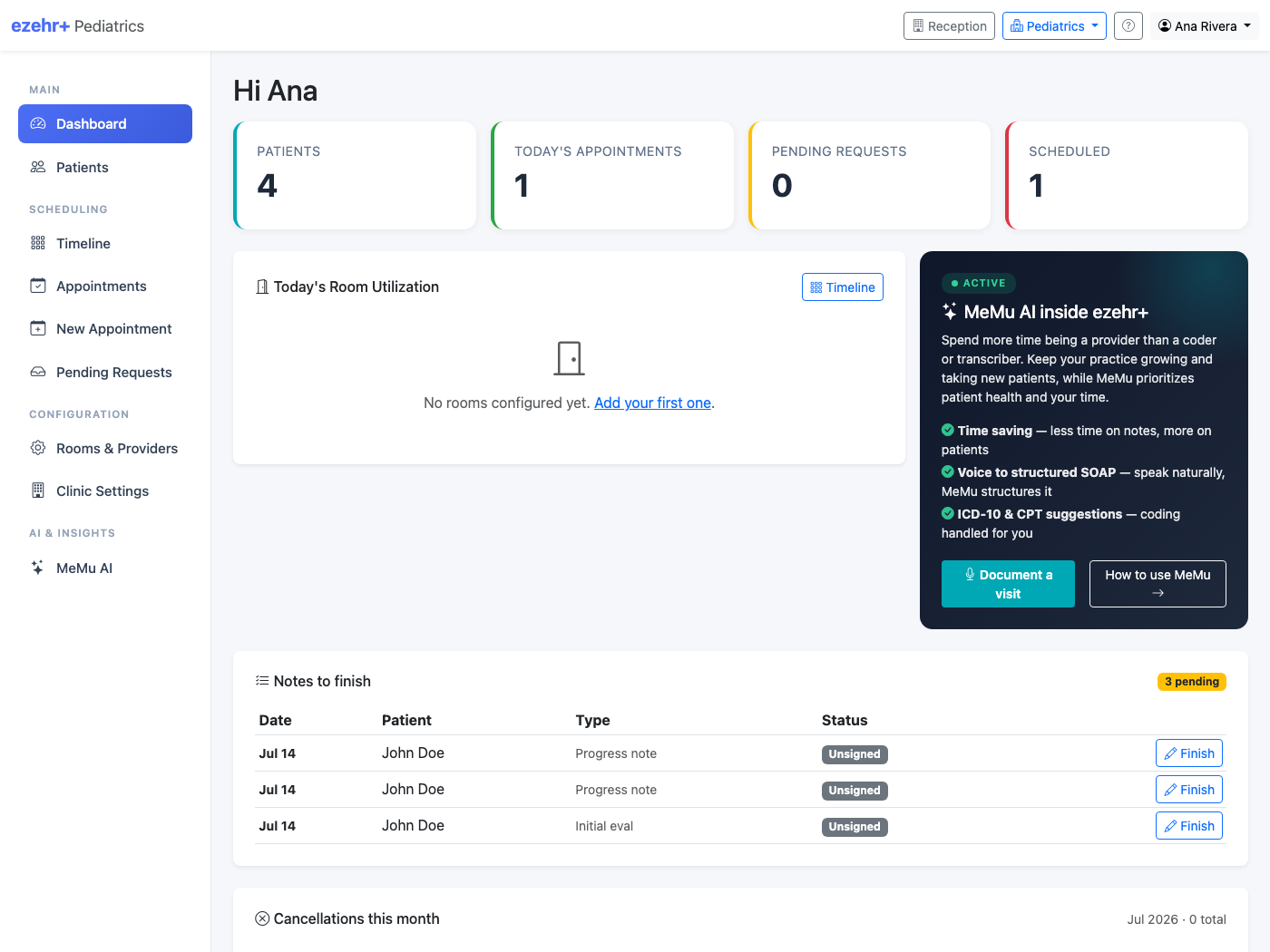
The ezehr+ dashboard: room utilization, today's caseload and notes to finish
4Specialties on one codebase — adding a fifth is a manifest, not a migration project
0Notes signed by the AI. Every draft waits for a licensed clinician
4Export formats: FHIR R4, C-CDA, printable and ZIP — with an audit trail
0sPatient audio retained. It is deleted the moment it is transcribed
Clinical documentation

The last mile of the visit, written for you.

This is the reason a clinic buys ezehr+. It does the ordinary work an EHR must do — patients, scheduling, rooms, notes, billing codes, record export. What is different is what happens when the visit ends: it is already documented.

Four steps, one tap each

The workspace opens from any appointment. Intake and the consultation are captured as separate segments, on any device including a phone — and intake can be skipped in one tap, because physical therapists skip it routinely and the product has to let them.

  • The note knows what the chart knows. Reason for visit, relevant history and precautions already on file travel with the recording, so the summary reads the patient in context rather than only today's words.
  • A MeMu note and a typed note are the same note. The draft lands in exactly the structure a clinician would fill by hand, in the same editor. There is no second-class "AI note".
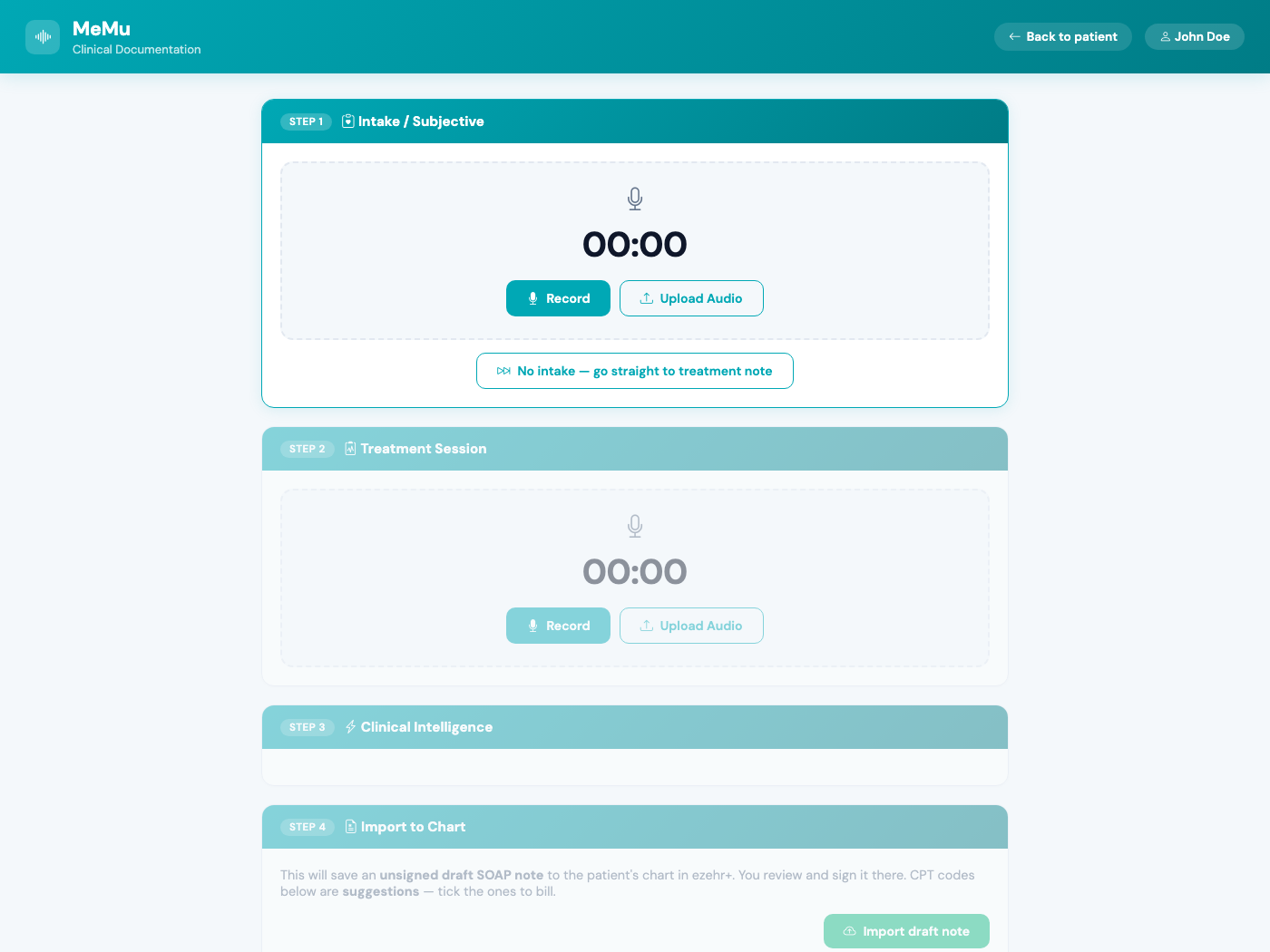
The MeMu clinical documentation workspace

The MeMu workspace, opened from any appointment: intake, the consultation, clinical intelligence, and import to the chart.

Record

Intake and consultation as separate segments, on any device. Audio can be uploaded instead of recorded. Intake is optional.

Transcribe

Speech becomes text on MeMu's own server. The audio is deleted immediately afterward and never reaches a third-party service.

Understand

One pass over the whole encounter: clinical entities, a drug-interaction screen, ICD-10 codes, CPT/HCPCS suggestions, and the specialty's summary.

Import

An unsigned draft SOAP note, attributed to the appointment's provider, filed under its specialty, with pain score and ICD-10 carried over.

MeMu never signs and never bills. Every note it produces lands unsigned. Every billing code it proposes arrives as a suggestion the clinician ticks. Nothing is auto-signed and nothing is auto-billed — and that is a product constraint, not a current limitation.

One engine, four packs

Each specialty looks, asks and writes like itself.

Physical therapy, pediatrics, general medicine and OB/GYN are not four installations or four products. Each is a manifest over one engine — its own color, vocabulary, intake, appointment types, note template, billing model and AI summary. All of it is data, not a fork of the code.

Physical Therapy

The most mature pack — the real-world testing ran in a physical therapy clinic, and this release brings the other three up to it.

Intake it collects
Referring provider, chief complaint, injury mechanism, relevant history, contraindications
Note it writes
SOAP with a 0–10 pain scale. Initial evaluation, progress note, re-assessment, discharge
Billing model
Medicare outpatient PT: 8-minute rule, KX threshold tracking
What its AI summary captures
Range of motion, strength (MMT), special tests, gait, posture, palpation, treatment performed, in-clinic and home exercise program, short- and long-term goals
Physical Therapy in ezehr+

Physical Therapy. Room utilization, today's caseload, cancellation reporting.

Pediatrics

A well-child visit is not an office visit, and the pack knows the difference — from the intake it asks for to the note it writes.

Intake it collects
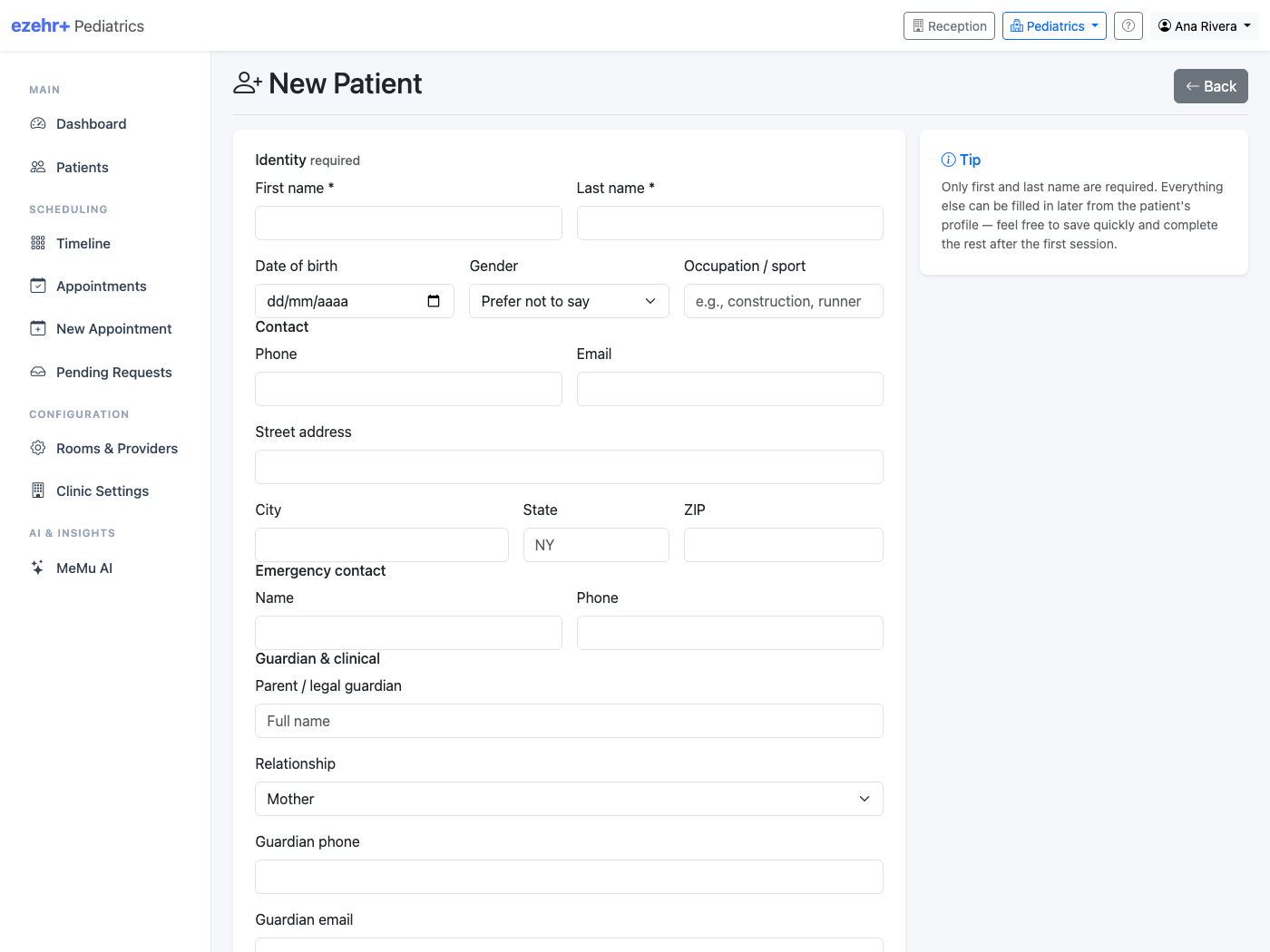
Guardian and birth details, growth, immunization status, allergies
Note it writes
SOAP framed as well-child visit, follow-up, growth & development review
Billing model
E/M visit — preventive visits, immunization administration
What its AI summary captures
Who gave the history; growth with percentiles; developmental milestones by domain; immunization status, given and due; anticipatory guidance and return precautions
Pediatrics in ezehr+

Pediatrics intake. The same screen and the same engine, a different pack: guardian and birth details. Neither form is a special case in the code.

General Medicine

The generalist's world: chronic conditions, medications and the long history that a good note has to carry forward.

Intake it collects
Reason for visit, chronic conditions, medications, surgical, family and social history
Note it writes
SOAP framed as new patient / annual, office visit, chronic care review
Billing model
E/M visit — office visit levels, in-office tests
What its AI summary captures
History of present illness, symptoms, review of systems; vitals and physical exam; labs and imaging; chronic conditions and medications; medication changes, orders, follow-up and return precautions
General Medicine in ezehr+

General Medicine. The same dashboard, this specialty's providers, rooms and vocabulary.

Women's Health

Obstetric care has a vocabulary of its own, and a form built for a knee injury cannot hold it.

Intake it collects
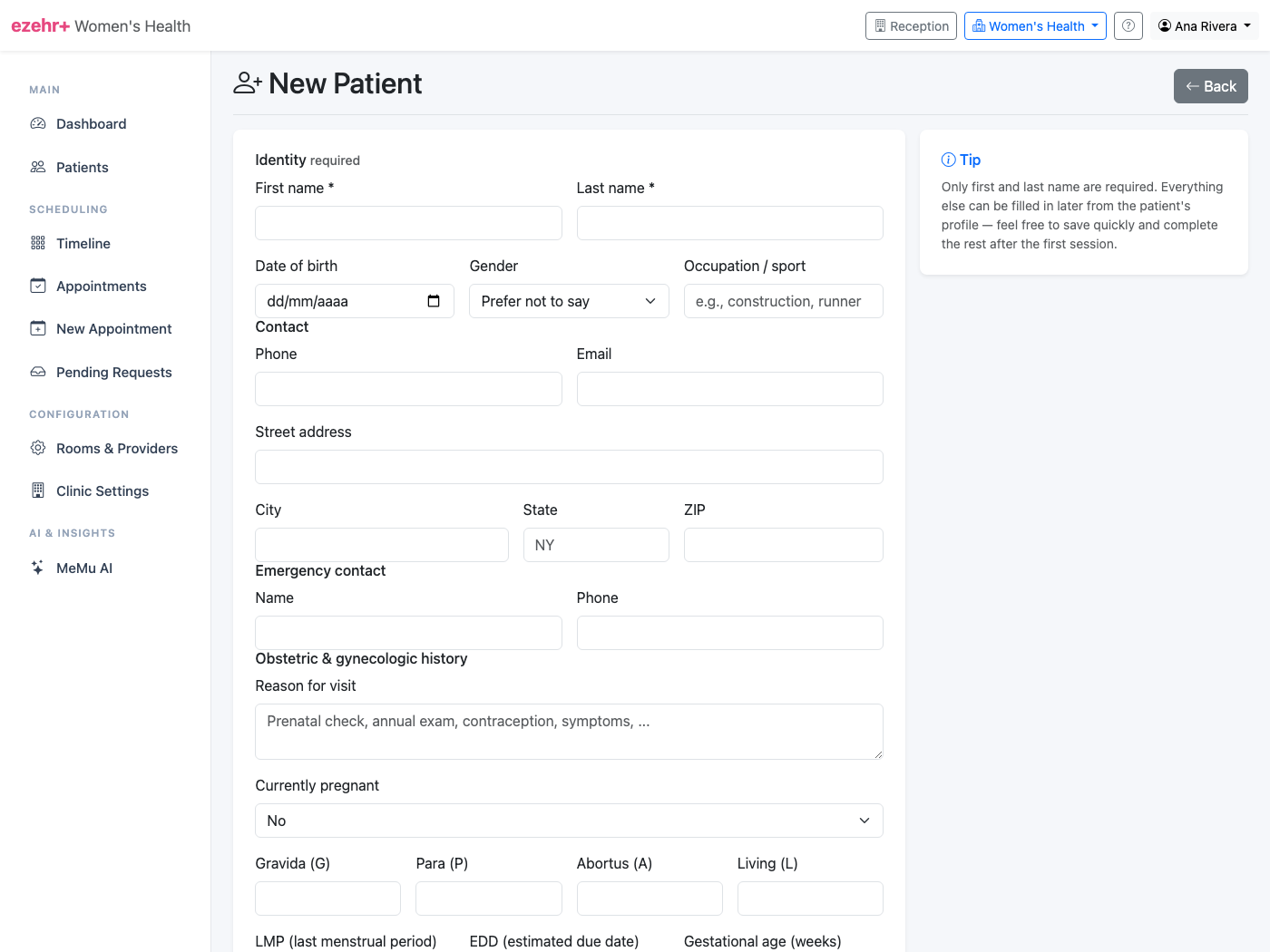
G/P/A/L, LMP, EDD, gestational age, pregnancy risk, Pap and mammogram history, contraception
Note it writes
OB visit note: new OB/GYN visit, prenatal visit, gynecologic exam, postpartum
Billing model
E/M visit — obstetric care, ultrasound, gynecologic procedures
What its AI summary captures
Gravidity/parity, LMP, EDD and gestational age; fundal height, fetal heart rate and presentation; cervical, pelvic and breast exam; labs and imaging; risk factors; screenings and warning signs
Women's Health in ezehr+

OB/GYN intake. Gravida/Para/Abortus/Living, LMP and EDD, gestational age, pregnancy risk, Pap and mammogram history, contraception — fields that exist in no other world.

A patient is clinic-wide; a visit is not. The same person can be seen by the physical therapist on Monday and the obstetrician on Thursday without being duplicated. What is scoped to a specialty is the appointment, the note, the room and the provider — because a hydrotherapy pool is not an OB/GYN room, and a prenatal visit is not a PT session.

A single-specialty clinic never sees any of this. When only one specialty is enabled, sign-in goes straight to the dashboard and the reception layer and specialty switcher disappear. The rural doctor gets a rural doctor's EHR.

Scheduling

Booking that matches how a clinic really runs.

A physical therapist does not see one patient at a time. They have one on the bike, one in the gym and one on electrotherapy, all in the same window. An EHR that treats every professional as exclusively booked is unusable in that room — so ezehr+ does not.

A concurrent cap, not a lock

  • A professional carries a concurrent cap — several patients in the same window, up to a limit the clinic sets (six by default).
  • Except when the treatment demands undivided attention. An appointment type can declare itself one-on-one, reserving the professional exclusively. Vestibular therapy, women's health and dry needling are flagged this way out of the box.
  • Rooms have their own capacity, independent of the professional: a shared gym takes several people, a private cubicle takes one.
  • Rooms belong to a specialty — a hydrotherapy pool is never offered to an obstetrician.
  • All of it is checked live as the form is filled, not after saving.
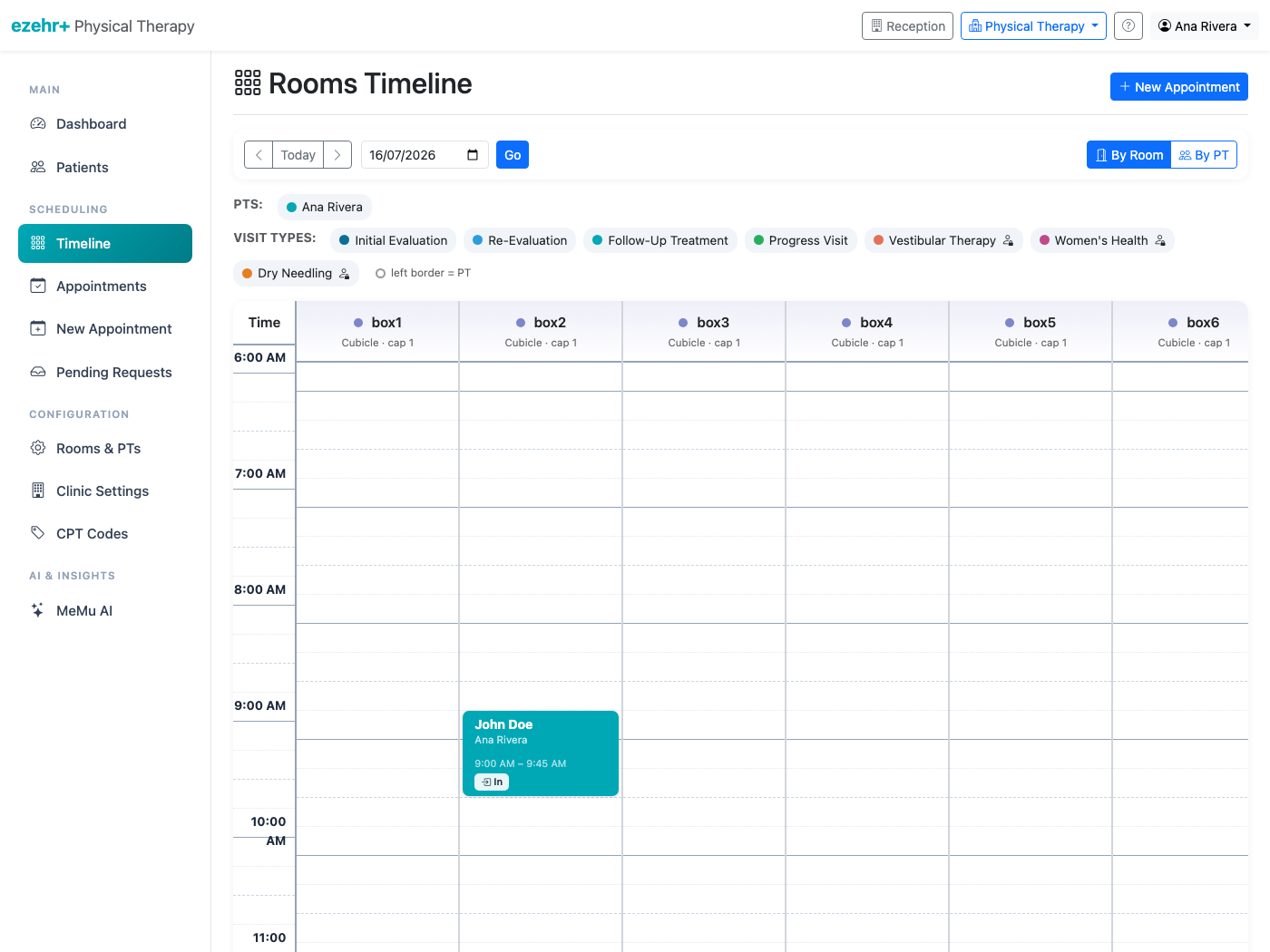
The room timeline across the working day

Timeline. Every room across the working day. Click an empty slot to book into it; the panel updates live — green means free, red means taken.

Patients can book themselves

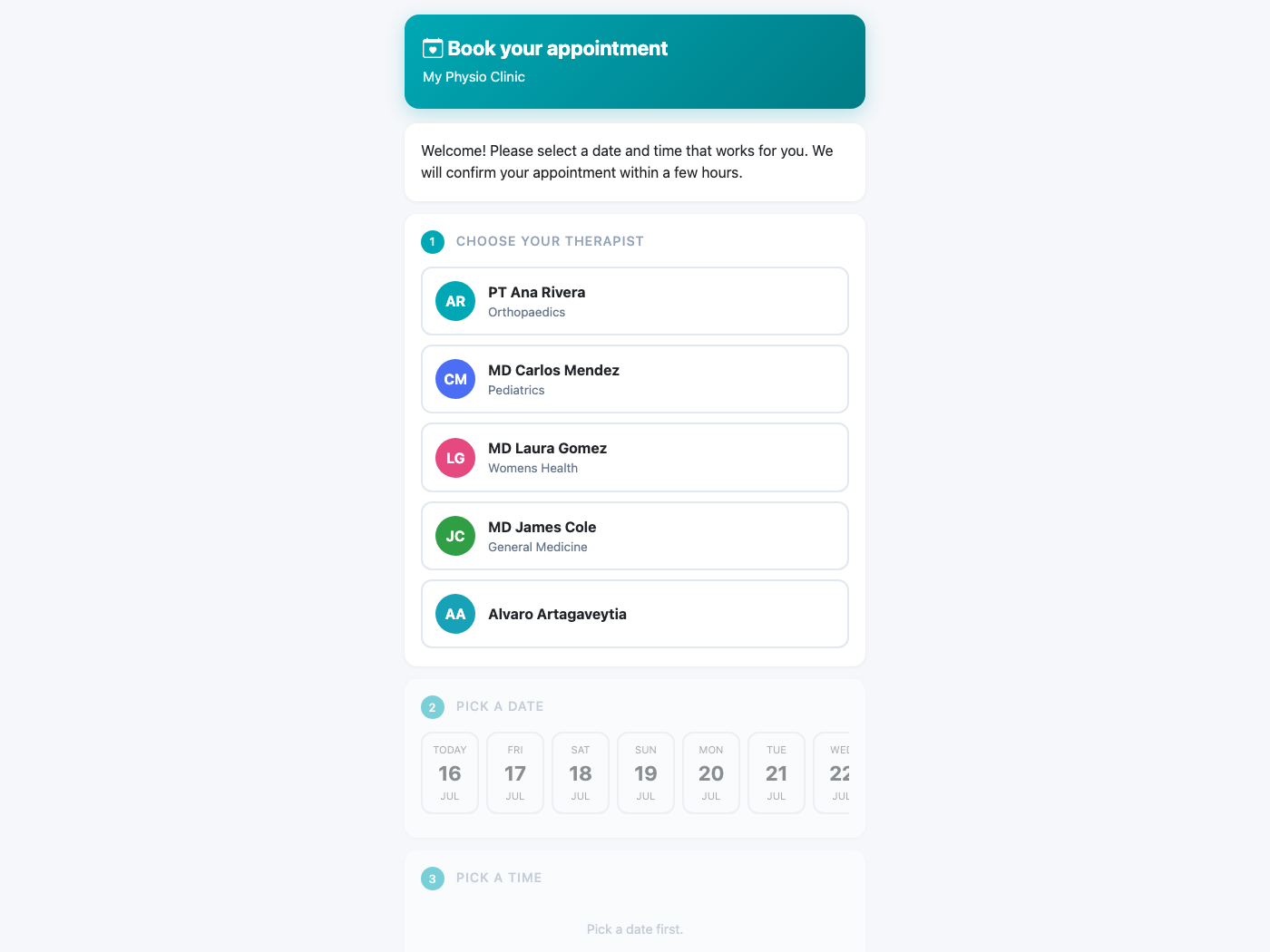
A link the clinic shares — in a WhatsApp Business profile, an Instagram bio, a website. No login. Requests land in a queue for staff to approve or decline; they never write straight into the diary.

The visit then runs a lifecycle the clinic can report on: scheduled, confirmed, arrived, in progress, completed — with check-in and check-out timestamps, plus cancelled and no-show with structured reasons that feed the dashboard.

The public booking widget

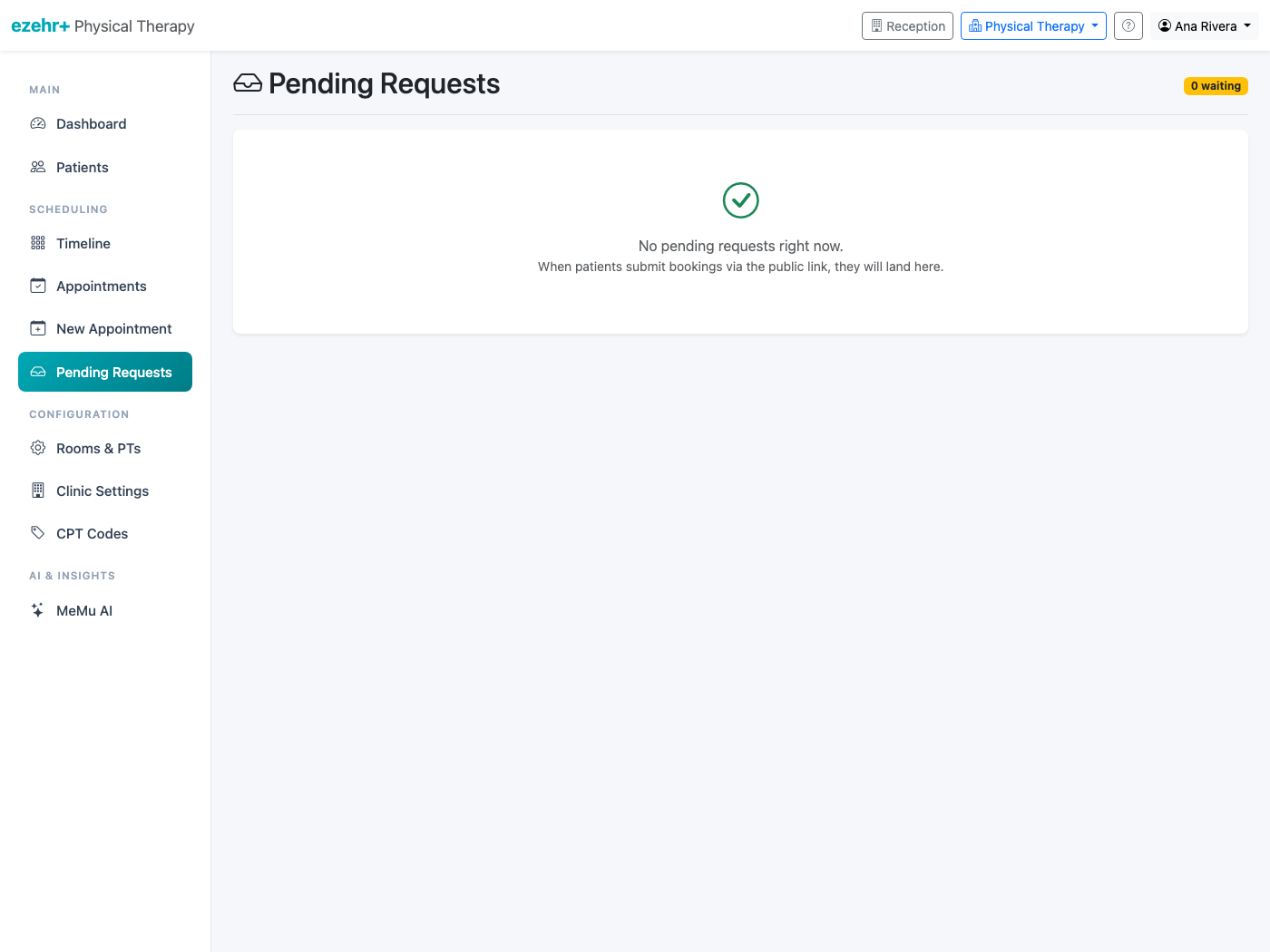
Public booking. No login, and no direct write: every request waits for staff approval in the pending queue.

The chart and the bill

Notes a clinician signs. Codes a clinician ticks.

The note editor

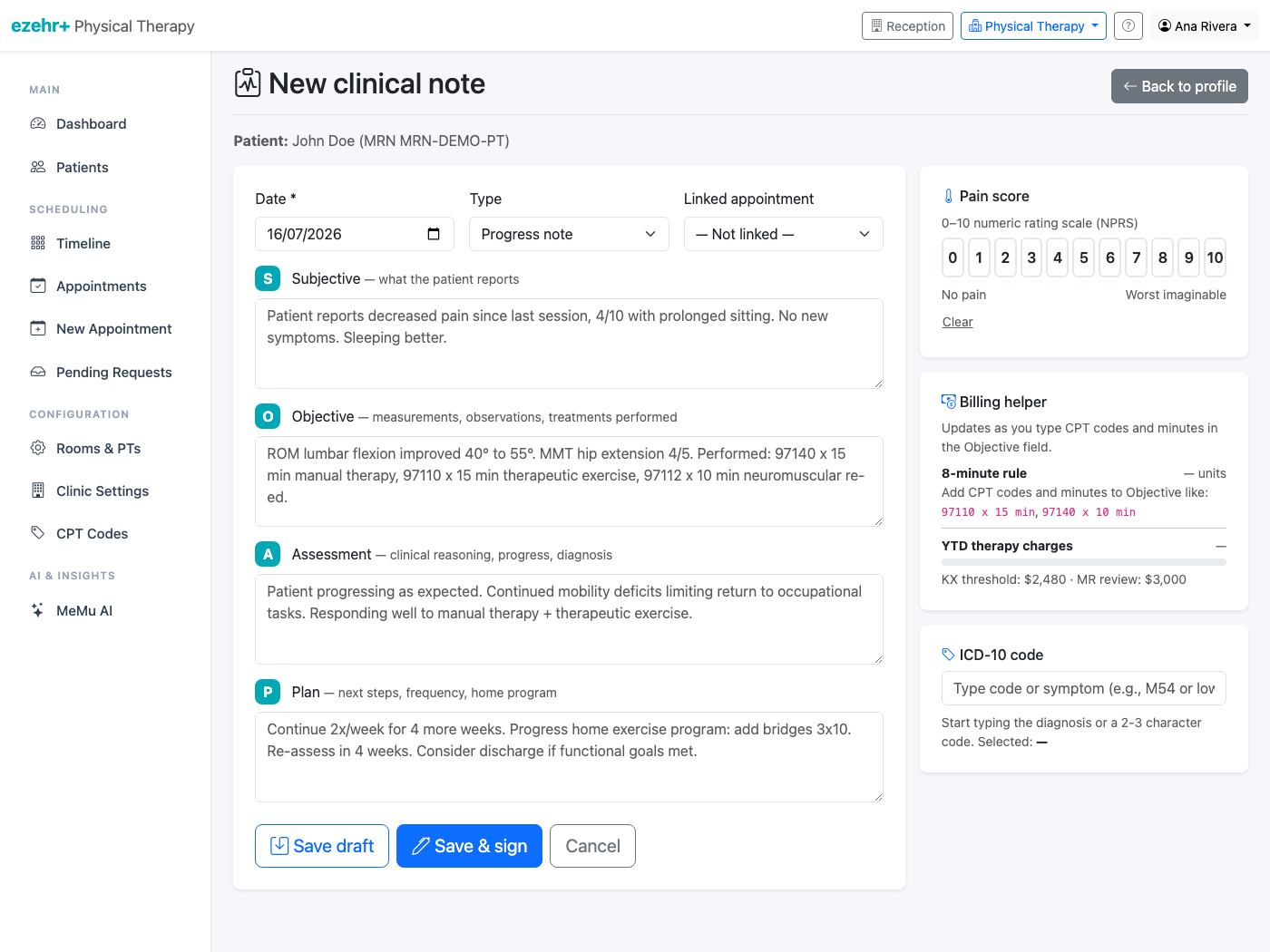
Notes are SOAP — subjective, objective, assessment, plan — with a pain scale where the specialty uses one, an ICD-10 code searchable inline, and a record type drawn from that specialty's vocabulary. A note is a draft until the clinician signs it, and signing stamps who signed and when.

For physical therapy, a live billing helper counts 8-minute-rule units and tracks the Medicare KX threshold as the note is typed.

The SOAP note editor

The note editor. Each specialty supplies its own field labels, hints and examples — this is the physical-therapy phrasing.

The catalogue is the gate

MeMu proposes codes from what was actually said in the visit. The clinician ticks the ones to bill and sets units. Each code is then validated against the clinic's own catalogue — anything unknown is rejected and reported, never silently written.

Per-specialty billing models: Medicare outpatient PT for therapy (8-minute rule, KX threshold), E/M visit for general medicine, pediatrics and OB/GYN. No 8-minute rule outside therapy, because it does not apply there.

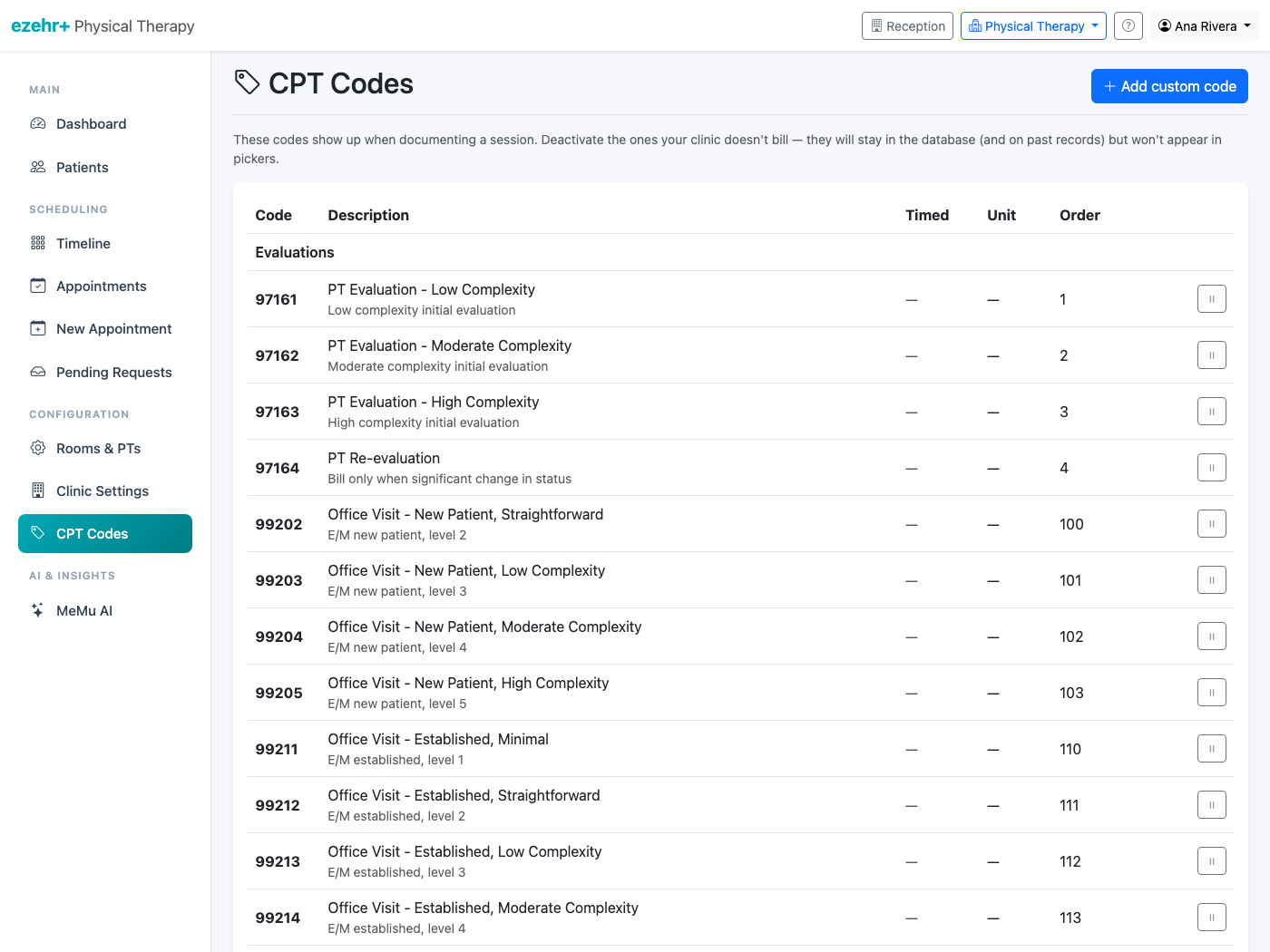
The CPT catalogue

The CPT catalogue. The clinic's own list of what it bills. It ships as a starting point, not a fee schedule — each clinic curates it against its payer contracts before billing.

Interoperability

A record the clinic cannot hand over is not a record.

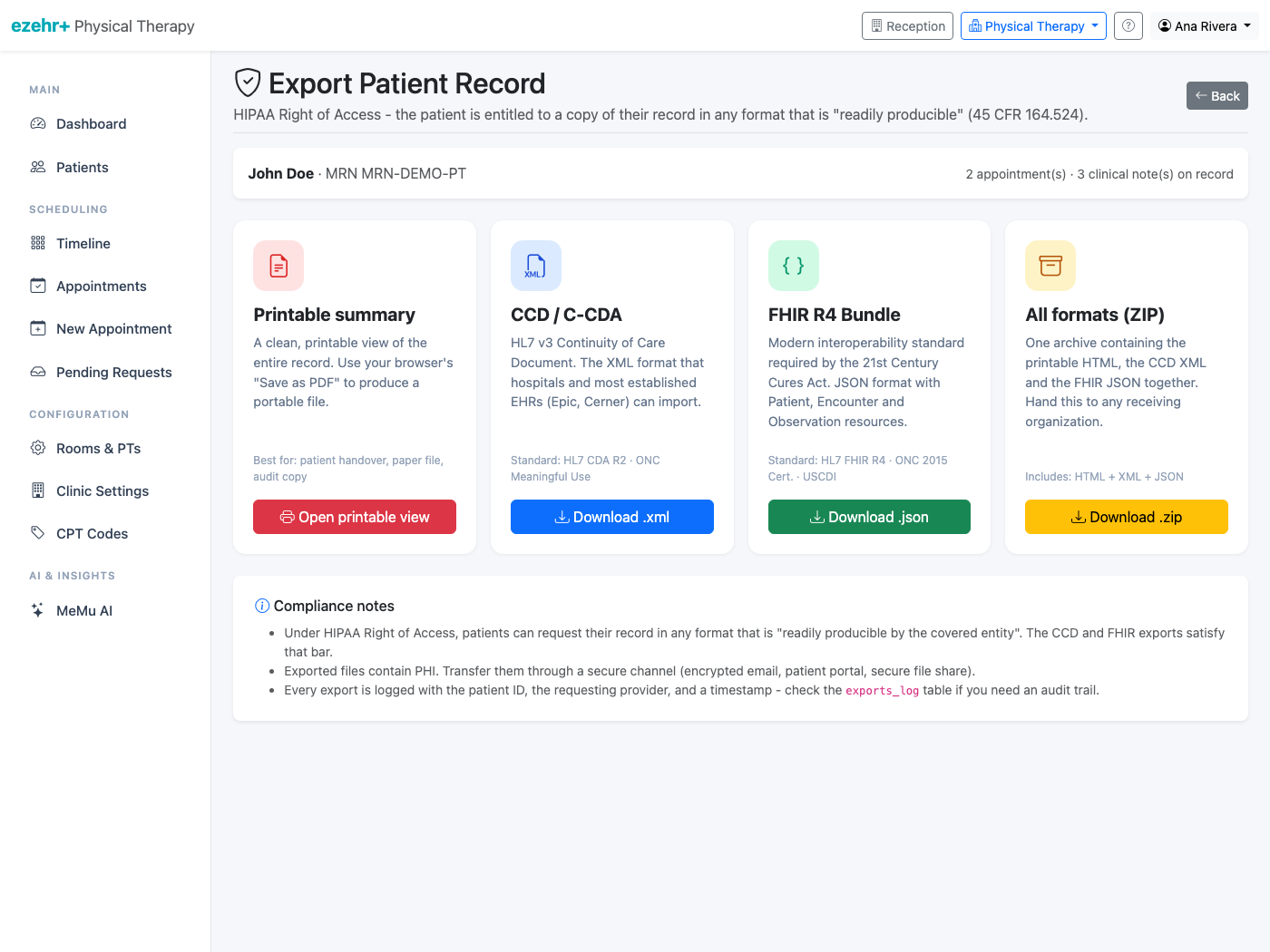
ezehr+ exports the whole chart in the formats the rest of American healthcare actually reads — framed by the obligation it serves: HIPAA Right of Access, the patient's entitlement to a copy of their record in any form that is readily producible (45 CFR 164.524).

FHIR R4 Bundle

HL7 FHIR R4 · ONC 2015 · USCDI

The modern interoperability standard required by the 21st Century Cures Act. Patient, Encounter and Observation resources as JSON.

CCD / C-CDA

HL7 v3 CDA R2 · Meaningful Use

Continuity of Care Document — the XML hospitals and established EHRs import on a transfer of care.

Printable summary

HTML → PDF

Patient handover, the paper file, an audit copy.

All formats

ZIP

One archive to hand to a receiving organization or upload to a portal.

Every export is on the record

Each export writes an audit row: which patient's chart left, in what format, at the request of which provider, when, and from which IP address. The trail is a first-class table in the schema, and an export that could not be logged is reported as such rather than passing quietly.

Exported files contain PHI. The product says so on the screen and tells staff to move them over a secure channel — because compliance is a workflow, not a checkbox, and the product's job is to make the obligation visible at the moment of the act.

The export hub

Export hub. Four formats, one screen.

Architecture

The AI runs behind the EHR, never in the browser.

That single decision is what makes the integration auditable, meterable and safe to evolve. ezehr+ calls the MeMu SDK server-to-server — an authenticated, metered, versioned clinical-AI API. The browser only ever talks to its own origin.

  • Patient audio never leaves MeMu's server and is deleted immediately after transcription.
  • The SDK stores nothing — no sessions, no patients, no transcripts. Clinical data lives in the clinic's own database.
  • The AI key is server-side and never reaches the browser.
  • Chart context is resolved server-side from the appointment — a browser cannot forge a patient's history or choose which clinical flavor runs.
  • Every AI run is retained for audit, linked to the note it produced. If a note is ever questioned, the exact material the draft came from is still on file.
  • Every record export is logged with patient, format, provider, timestamp and IP.
The MeMu AI capability page inside ezehr+

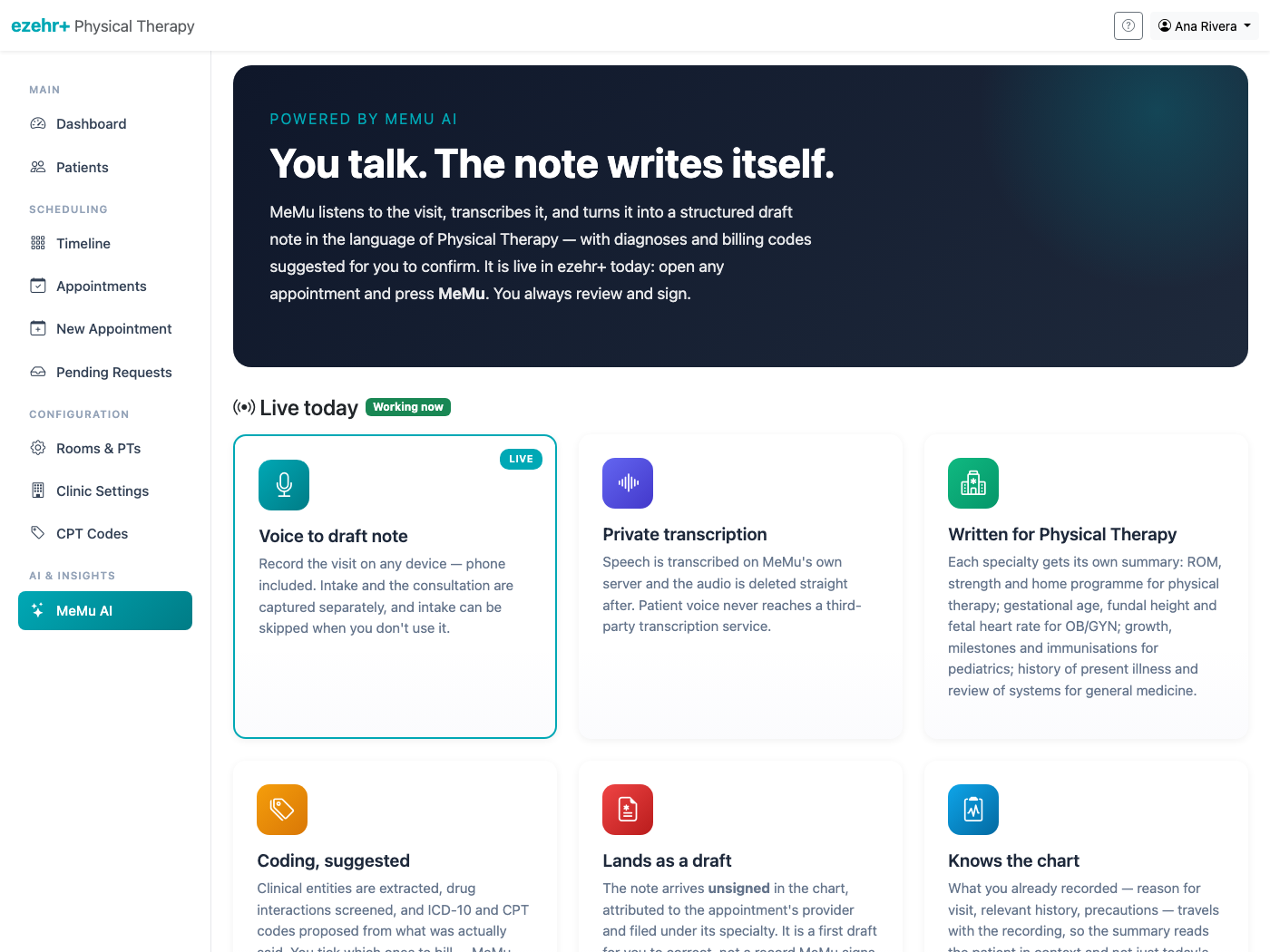
MeMu AI inside ezehr+. The capability page follows the active specialty, and separates what works today from what is genuinely on the roadmap.

Two vendors, on purpose. Clinical reasoning uses Claude (Anthropic). Transcription uses Whisper (OpenAI), running on MeMu's own server — not as a hosted API. The honest framing is best tool per task, with a privacy consequence that matters more than either brand: the patient's voice never leaves the server.

Underneath: PHP 8.2 and MySQL 8, server-rendered. It runs on ordinary managed hosting — no container platform required.

The whole product

Every screen, as it actually is.

These are captures of the running application — not mockups, not concept art. Click any of them to look closer.

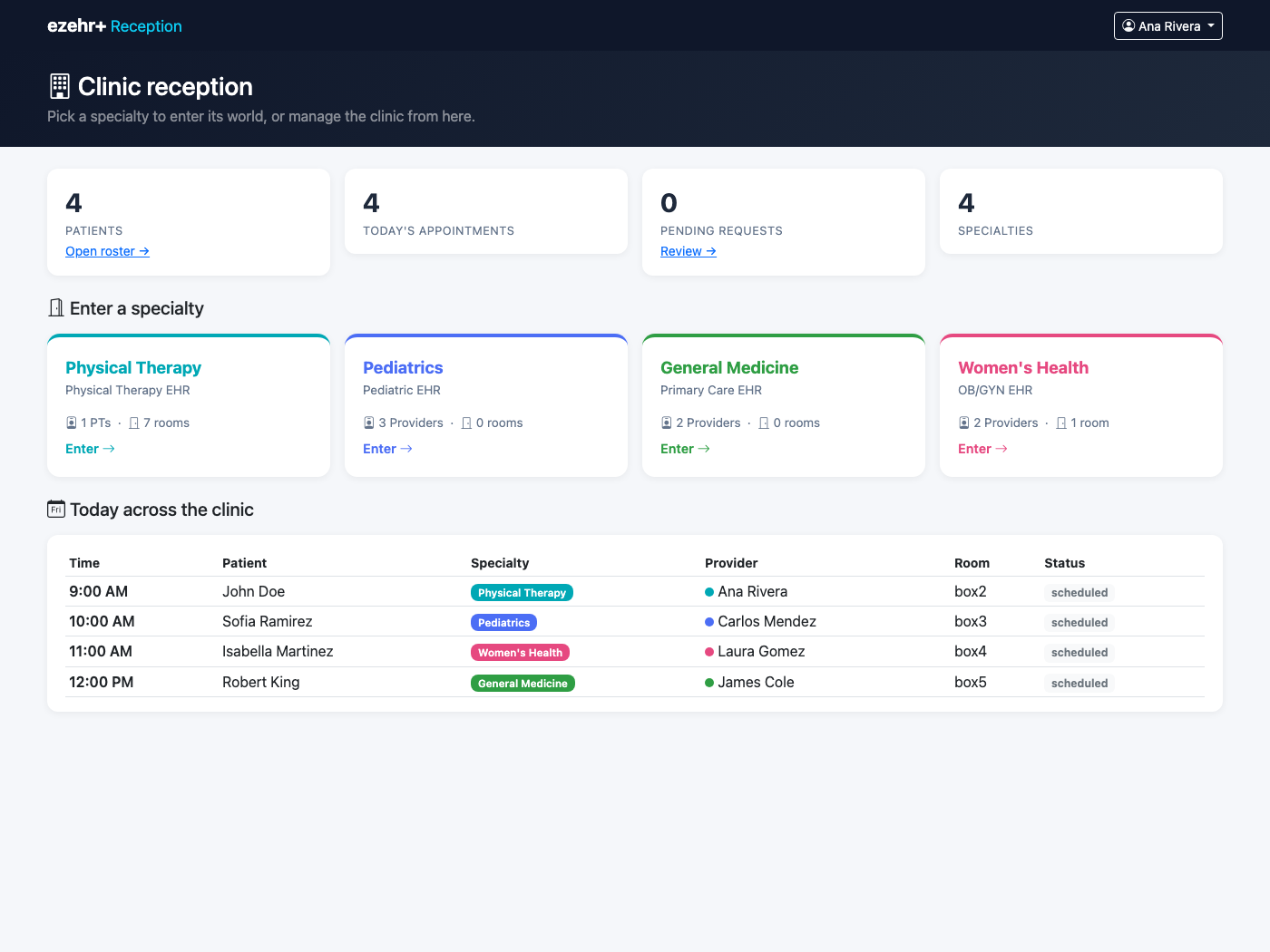
Clinic reception — the day across every discipline
Physical Therapy dashboard
General Medicine dashboard
Women’s Health dashboard
Pediatrics dashboard
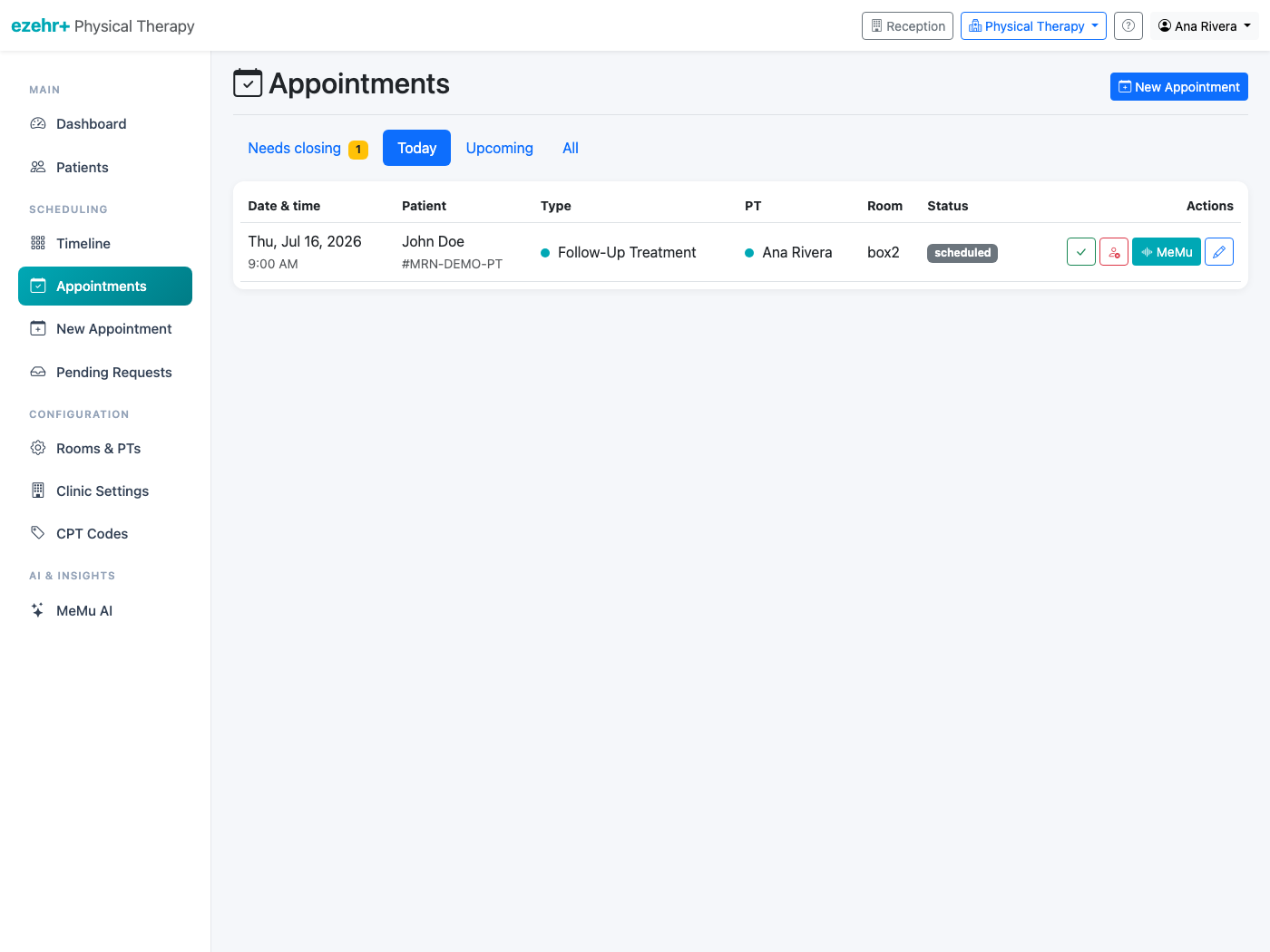
The clinician’s board — opens on today
Room timeline — every room across the day
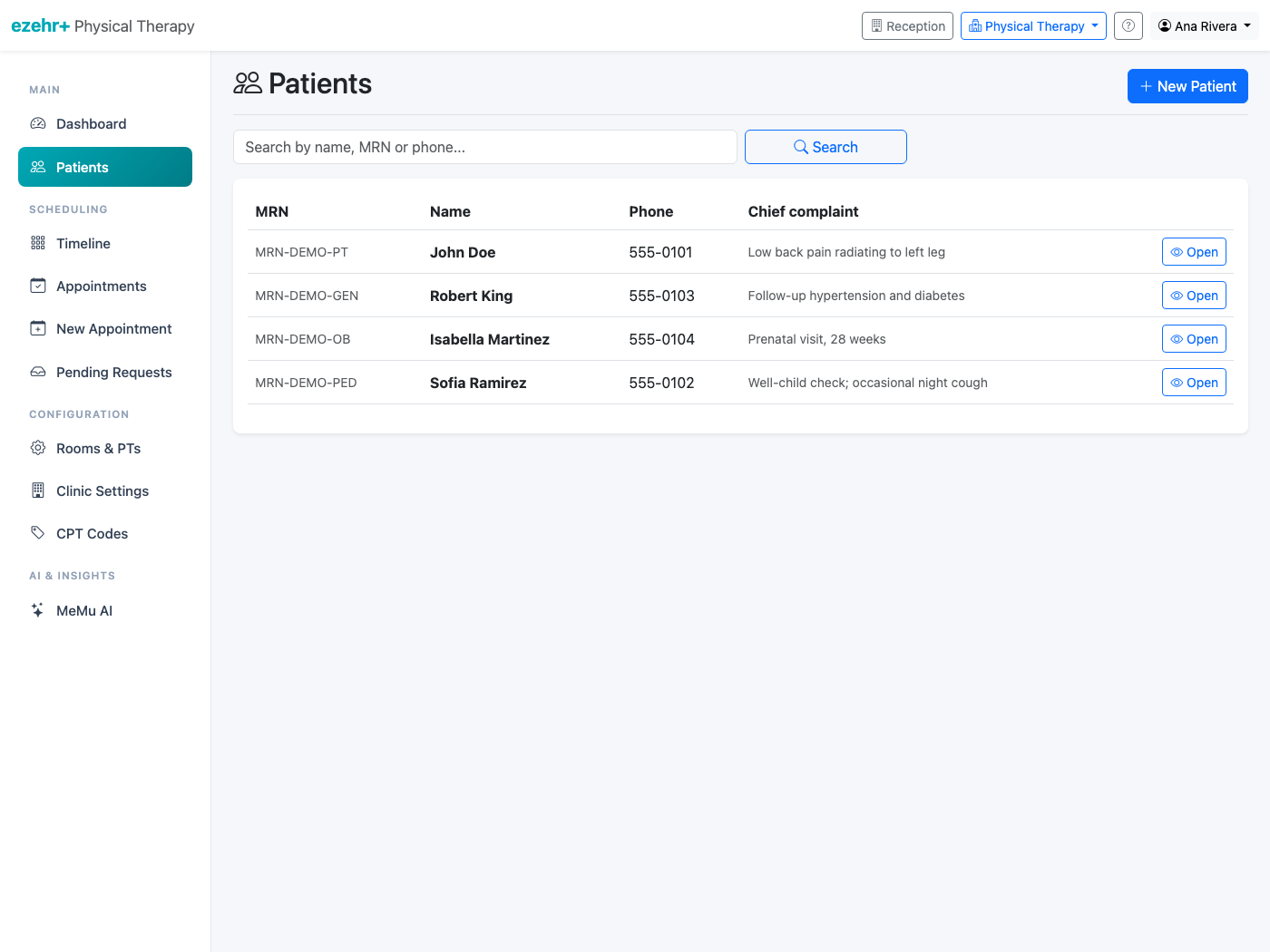
Patient roster — one person, known once
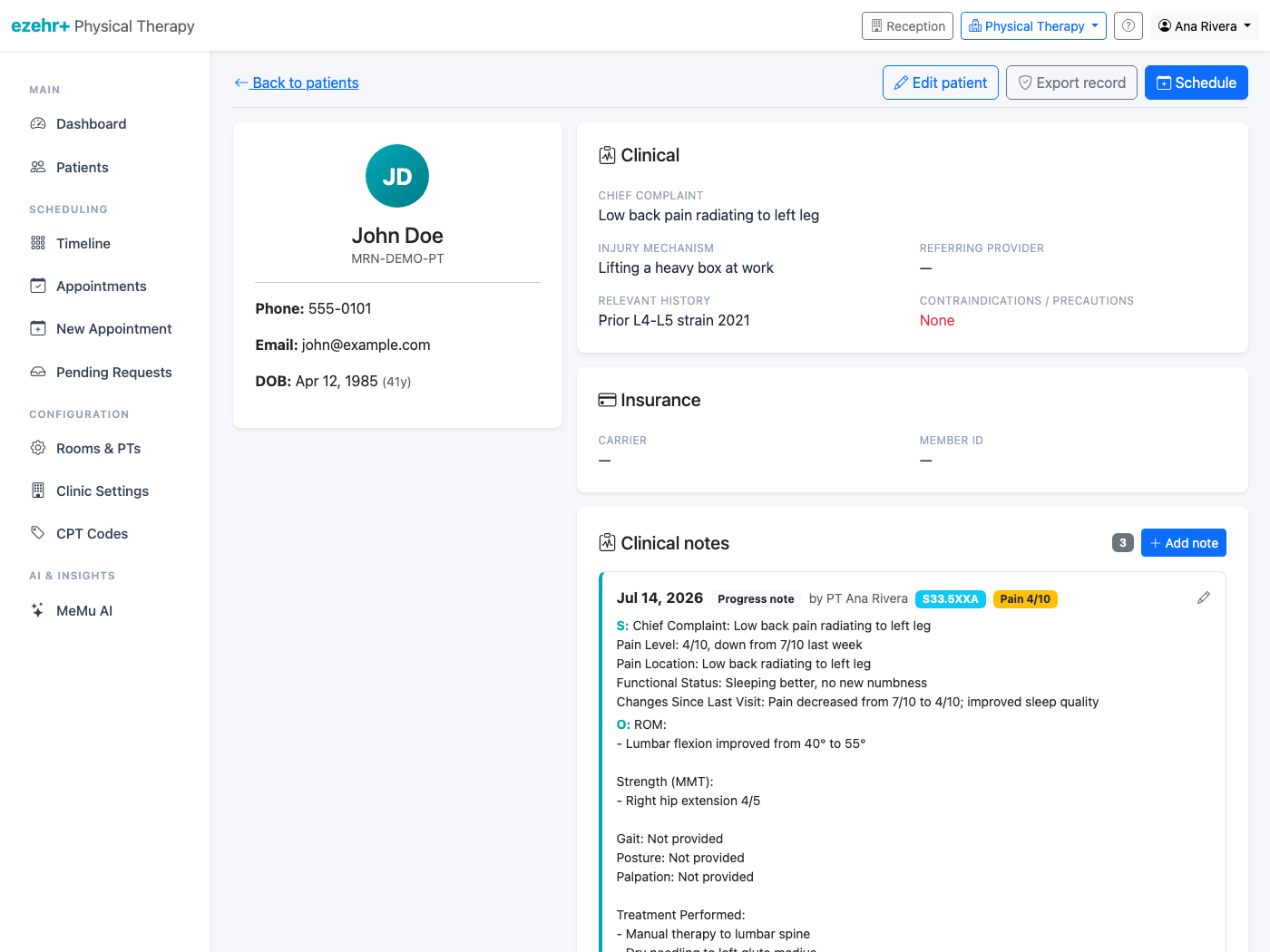
The chart — intake, visits and notes on file
SOAP note editor with live billing helper
MeMu workspace — record, transcribe, import
CPT catalogue — the clinic’s own billing list
Export hub — FHIR, C-CDA, printable, ZIP
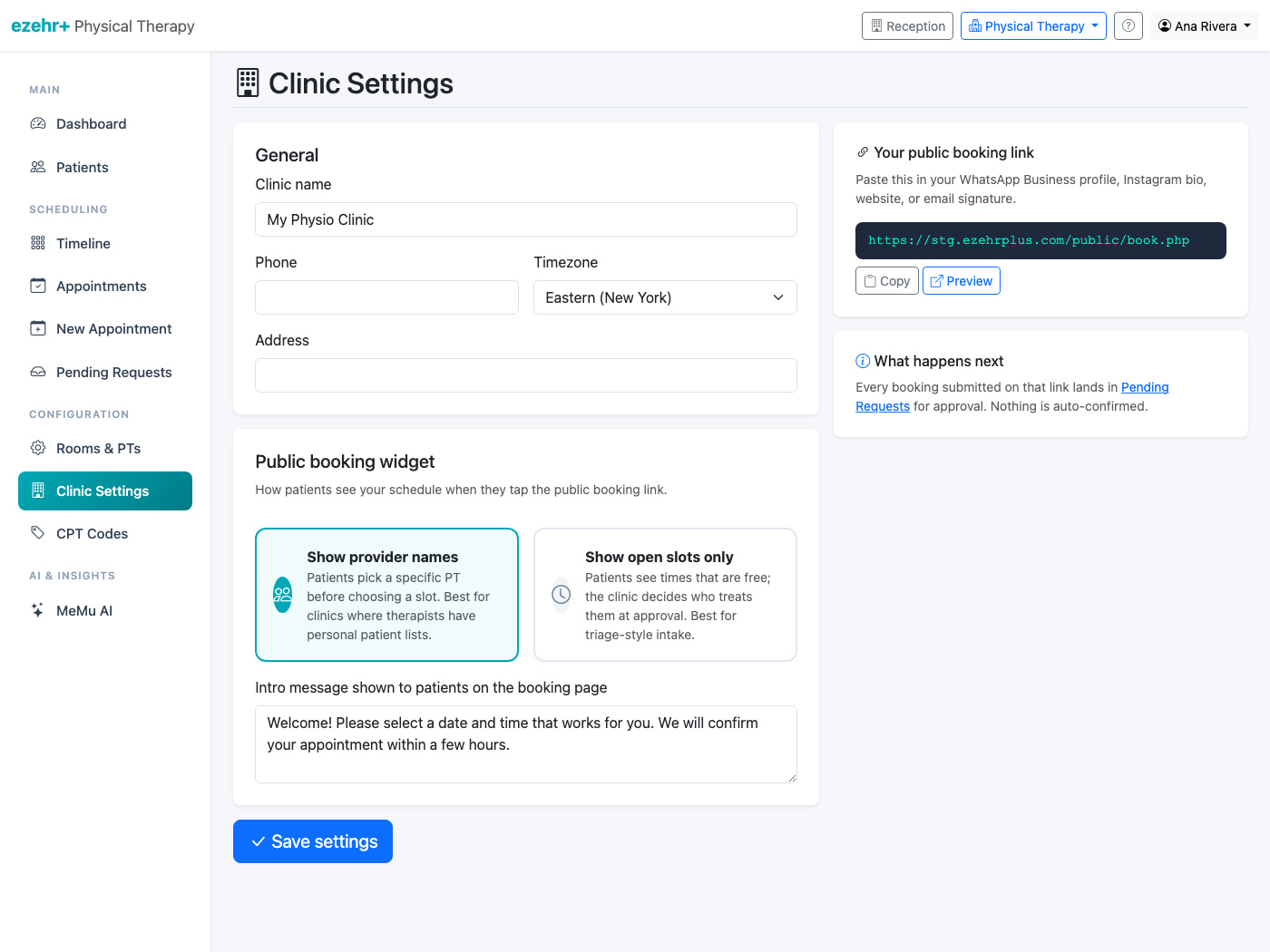
Clinic settings — identity, hours, booking policy
Pending requests — public bookings await approval
OB/GYN intake — G/P/A/L, LMP, EDD
Pediatrics intake — guardian and birth details
Public booking — a link the clinic shares
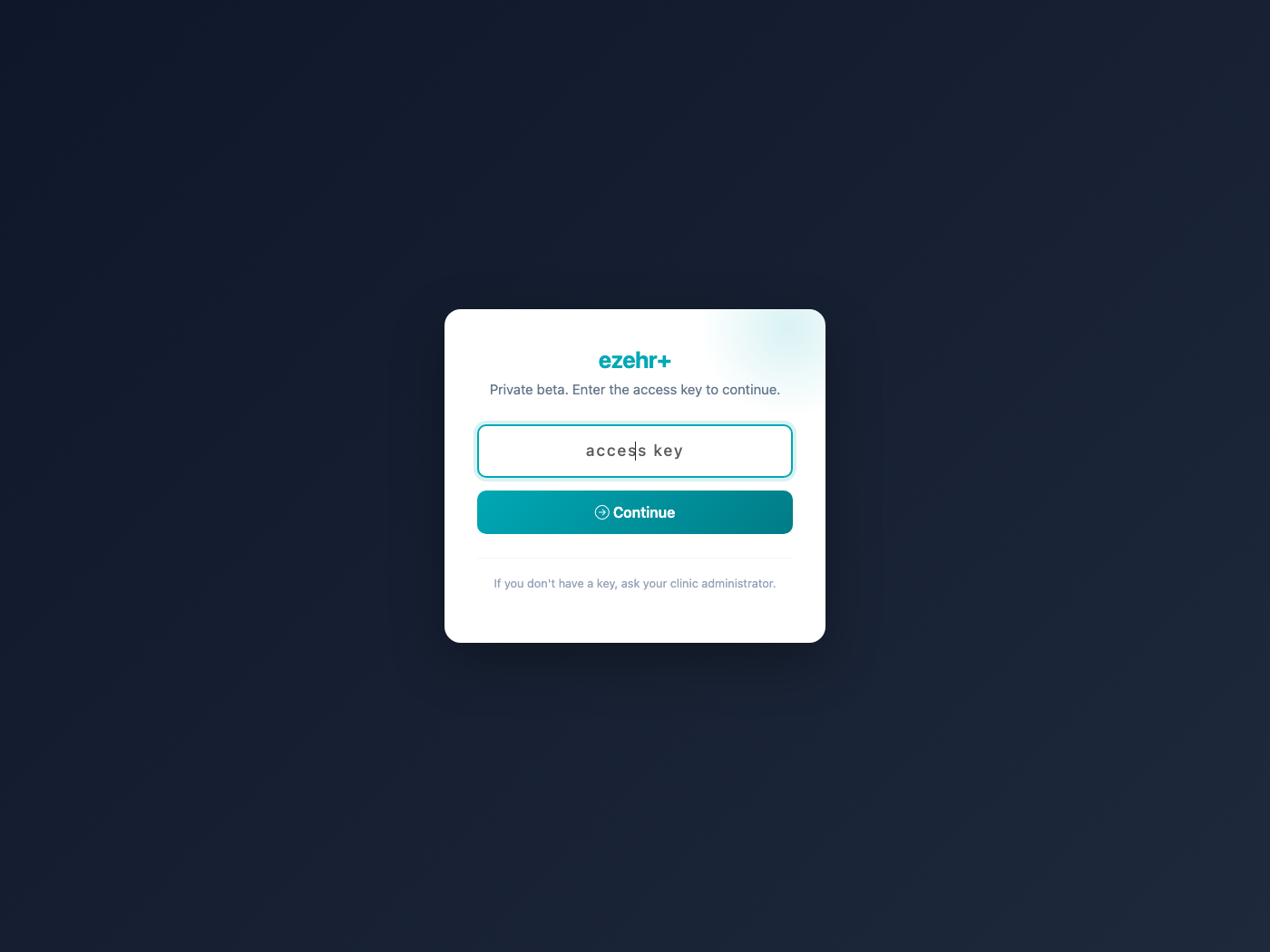
Welcome — choosing a specialty to enter
MeMu AI — the capability page follows the specialty
PDF

The full product documentation

Everything above, plus the architecture, the data model, the billing models and an honest account of what is verified and what the final round of testing is for.

Download

Stop taking your notes home.

Start with one specialty or all four. It runs on ordinary hosting, and the clinician always has the last word.

Free trial — coming soon Download the documentation